20 April, 2010

Consumerism in China - the story of America retold

Deng Xiaoping's 1979 reforms opened China's frail, Communist, isolated command economy to the invigorating forces of foreign financial and industrial capital. Since then, China has imported a number of things, at an ever increasing rate; one of these new ideas , is consumerism.

Anne Leonard's short documentary, The Story of Stuff, simplified the Work-Watch-Buy cycle of people absorbed in consumer-culture. There was a time, during the era of Mao, when people were citizens, and when people lived lives free from the temptation to buy everything they could, and spend everything they had.

A 1950s-era Chinese family gathers around a meal in the People's Communes; they live a simple life - the only option afforded to them by the economic system of local self-sufficiency and government cupons.
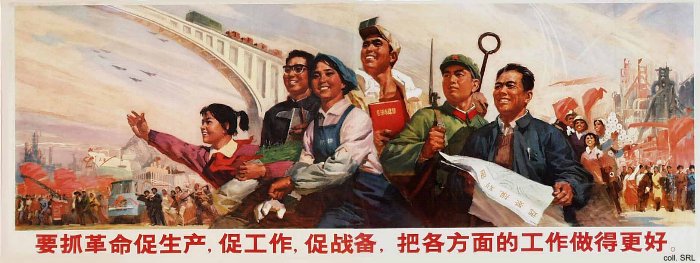
Living simple lives, the Chinese peasants and urban proletariats alike fulfill the stereyotypes of their societal role, armed with the characteristic tools of their work. In these posters, the hard working characters/models do not indulge in physical or material pleasures, but are enticed to live life only as productive members of society, and not consumers that seek to live life lavishly.

Propaganda posters of the times function as the advertising of the Chinese people under communism: they sell to the public ideas about work, education, "society", politics, and the world - ideas formulated by a public relations bureau somewhere in the halls of Chinese government. In the absence of commercial advertising, social advertising as such reflect the ideals of the people, or at least the ideals that the people are meant to have.

The ideals sold to the American public about the meaning of life, through the advertising of products marketed as means to that end goal of life, were very different at the time.
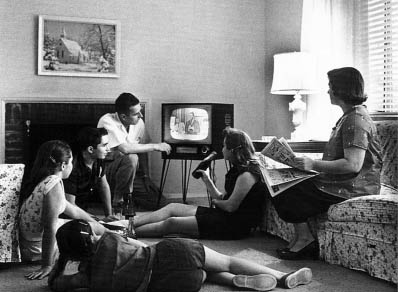

The advertising of the 1950s and 60s united family values developed through American history with material objects. Pastimes, family rituals, sacred family spaces, even the idea of love, were tied to commerical goods. Americans tied happiness and the goals of life to material consumption, and the cycle of Work-Watch-Shop described byLeonard began.

How did consumerism manifest itself in China? Socio-economic forces during the 1960s and 70s pushed China to experiment with currency, free-enterprise, international trade, and private investment. The political event of Mao's death allowed capitalist-leaning ideologues to rise to the highest levels of government, bellowing calls for social and economic reform.


Today, China's urban youth and middle-aged population save less, and consume more of every dollar they recieve. Chinese youth splurge on electronics, fashion, entertainment - none of which are exclusive to the younger generation.

Since incomes of younger Chinese are not neccesarily higher than average, and their exposure to material goods is not greater than any other urbanite, there has to be deeper cultural forces at work changing the younger generation.

Simple economic reform does not explain change in attitudes toward consumption. However, economic reform has allowed an influx of Western-versions of the corporation, media, and advertising - all of which are the spokes holding together the spiral of consumption in the West.

16 April, 2010

Women and the World

The day after Andover was out for winter term, I was in Manhattan with my mother who had flown in from Beijing. We both checked into the hotel and rushed to get ready for the three day "Women in the World" conference my mother was attending.

The star-studded guest speakers line up was jaw-dropping. I was looking forward to sitting before and asking questions of Hillary Clinton, Meryl Streep, Queen Rania, Christine Amanpour, Katie Couric, Campbell Brown, Diane Sawyer, and Juju Chang, and some other female business, media and political/feminist leaders.

The conference was held in a fancy midtown hotel decorated with surveillance and security equipment, spotted with Secret Service lurking near curtains and doors. The press lined up outside the hotel as the speakers arrived for the dinner. I sat at a table of complete strangers, far to the side of the room away from the celebrities in the middle, that turned out to be filled with the most interesting of guests (one of which was the best-selling author of one of my favorite controversial non-fiction Becoming Madame Mao and another that was a 98' Andover alumnae).

At that evening's three course dinner decorated with a lavish butterfly theme and bright orange (to blatantly advertise the sponsor's new laptops) with hundreds of people (mainly women in their 50s), the dinner enjoyed an inspiring speech and toast by Melanne Verveer - the U.S. Ambassador-at-large on Global Women's Issues. Here, she said (to quote loosely): "The 19th century was defined by the fight against slavery. The 20th was defined by the struggle for civil rights. And the 2st century will be defined by the quest for women's rights." This was a point later paraphrased by Secretary of State Hillary Clinton during her speech. Coming from two of the major foriegn-policy gurus of the United States, the radical role they saw women's rights playing in the future discussion of international relations and major issues was none other than an astounding level of foresight and confidence in this era's possibilities for unlocking women's rights and the potential of women.

Both Clinton and Verveer spoke that night

How women viewed the world, and how women participated in shaping the world, has never been an important question in international relations until more recent decades. In modern international relations discussion (which I am studying now), feminism is placed alongside the great schools of thought i.e. realism, liberalism, marxism, constructivism as an explanation of historical and current international trends, as well as being a valid direction for future foreign policy.

The school of thought called 'feminism' is based on the idea that gender-inequality, gender-conflicts and male dominance are fundamentals in understanding the functions of nations and peoples. This school seeks to create a new world order where inequalities between genders are eliminated, and equality is domestically and internationally enforced. They believe that violations of women's rights, such as sexual slavery, genital mutilation, honor killings, denial of access to education, legal and social acceptance of abuse against women, should be on par with issues such as censorship, liberalizing trade, nuclear nonproliferation, and others of environmental concern, etc.


http://www.huffingtonpost.com/2010/03/15/women-in-the-world-storie_n_498842.html%0A
http://www.undispatch.com/women-world-live-stream%0A
http://www.thedailybeast.com/blogs-and-stories/2010-03-18chinas-five-most-powerful-women/%3Fcid%3Dtopic%3Amainpromo3%0Ahttp%3A%2F%2Fwww.thedailybeast.comnewsmaker%2Fwomen-in-the-world%2F%0A

http:/content.usatoday.com/communities/kindness/post/2010/03%2Ftina-brown-women-in-the-world-summit-promotes-economic-empowerment-of-women-worldwide%2F1%0A%0A%0A%Pr